

The X-ray variability of Vela X-1
TALES doctoral candidate Vicente Madurga Favieres has recently published his debut scientific paper on the origin of the X-ray variability of the high-mass X-ray binary, Vela X-1. The research, set to appear in the journal Astronomy & Astrophysics, provides critical insights into how the complex environment surrounding the system’s neutron star influences its observed emission.
Vela X-1 consists of a highly magnetized neutron star accreting matter from the stellar wind of its supergiant companion. Due to the misalignment between the neutron star’s rotational and magnetic field axes, the resulting X-ray emission is observed as regular, intense pulses. The study used three XMM-Newton observations, from different years and at non-overlapping orbital phases, to demonstrate that the most pronounced variations in the X-ray pulsations over time are caused by absorption effects. This process dramatically suppresses the observed X-ray emission below approximately 3 keV. Variations at higher energies are likely related to changes in the density of the accretion flow onto the neutron star. The foundational work for this publication began during Vicente’s Master’s thesis at ESA/ESAC. The project subsequently expanded and evolved over the following years through productive research visits to Dr. Karl Remeis-Observatory (Bamberg, Germany) and the NASA Goddard Space Flight Center (Greenbelt, MD, United States).
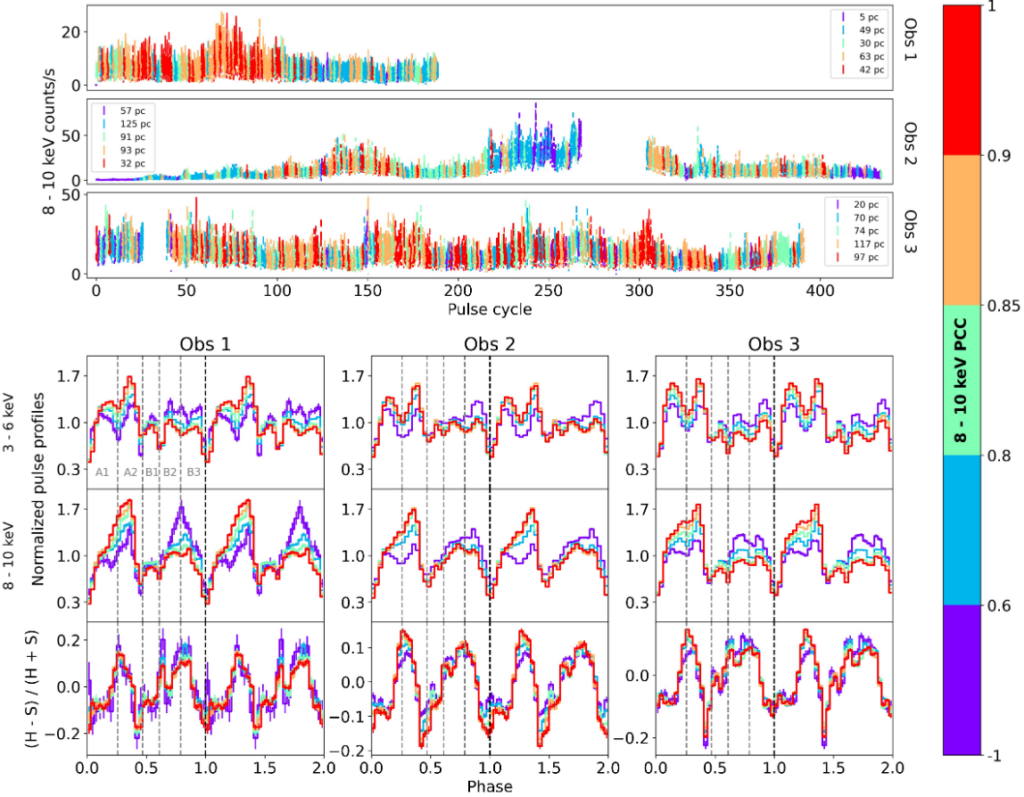
Figure caption: Top panels: 8–10 keV PCC-resolved light curves with a time resolution of an individual phase-bin (∼8.86 s). The numbers followed by “pc” are the number of pulse cycles per PCC range. First two rows of the bottom panel: normalized PCC-resolved pulse profiles in the 3–6 and 8–10 keV bands. Last row of the bottom panel: hardness ratio between the 8–10 and 3–6 keV normalized pulse profiles.

