

A Magnetically Supported Disk–Corona Model for Changing-look Active Galactic Nuclei Transitions
TALES doctoral candidate Marios Kouzis has published his first scientific paper, proposing a magnetically supported disk-corona model as the physical mechanism behind the transitions of changing-look active galactic nuclei (CLAGN). The work, carried out at the Nicolaus Copernicus Astronomical Center (CAMK PAN) in Warsaw together with Agata Różańska, Debora Lančová, Bożena Czerny, and Dominik Gronkiewicz, was submitted to The Astrophysical Journal Letters at the end of June and is now published. It offers important insights into the physics driving the observed changing-look variability.
CLAGN are galaxies whose central engines undergo dramatic changes in luminosity and spectral type on timescales of months to a few years, at low Eddington ratios. These transitions are orders of magnitude faster than what standard accretion-disk theory predicts. While several models can reproduce parts of this phenomenology, none had simultaneously matched both the empirical Eddington ratios at which the transitions occur and their observed durations, across a sample of sources, from a single self-consistent set of disk solutions. This work shows that a magnetically supported disk–corona model reproduces both.
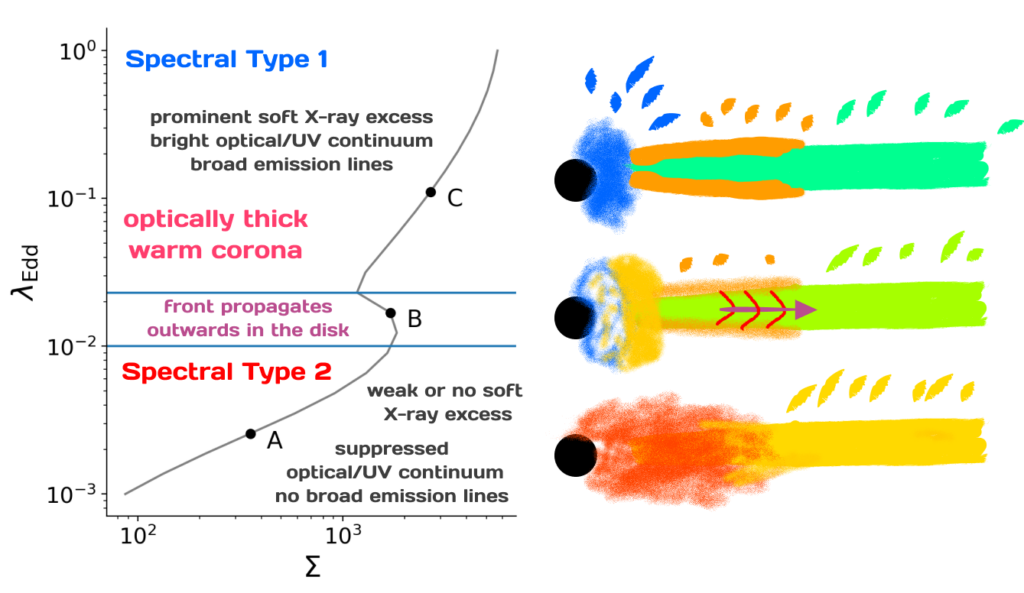
Figure Caption: The accretion states of a CLAGN across the magnetic S-curve. The left panel shows the thermally stable and unstable branches for a highly magnetized disk in the λEdd–Σ plane (relative accretion power vs surface density). The corresponding cross-sectional figures detail the disk and warm corona evolution. A stable Type 1 with a strong soft X-ray excess (C) destabilizes at the critical knee (B), where a front propagates outward on the timescale t_fp. The transition concludes on the radiatively inefficient lower branch (A), characterized by a vanished warm corona and a dim Type 2 spectrum
Using diskvert – a code that solves the steady vertical structure of an accretion disk under simultaneous gas, radiation, and magnetic pressure support, with a self-consistently generated warm corona – the team computed two key diagnostics: thermal–viscous S-curves and front propagation timescales. Across a large grid of models spanning different black hole masses, Eddington ratios, magnetic viscosities, and disk radii, both diagnostics point to the same conclusion: a highly magnetized disk–corona flow at small radii is required for a changing-look transition to occur. The strong magnetic support pushes the instability threshold down to the observed Eddington ratios (~0.01–0.03) and brings the transition timescale into the observed months-to-years range.
Importantly, the model was confronted with a sample of five well-observed CLAGN – Mkn 590, NGC 1566, IRAS 23226-3843, Mkn 1018, and NGC 2617 – and reproduces their observational signatures with the same requirement: the inner disk must be strongly magnetized. The case of Mkn 590, with its tightly constrained transition Eddington ratio, is especially constraining.
The research was funded by the EU HORIZON-MSCA-2023-DN Project 101168906 “TALES: Time-domain Analysis to study the Life-cycle and Evolution of Supermassive black holes”.

