

People of TALES – Meet Shashanth Sriramanathan
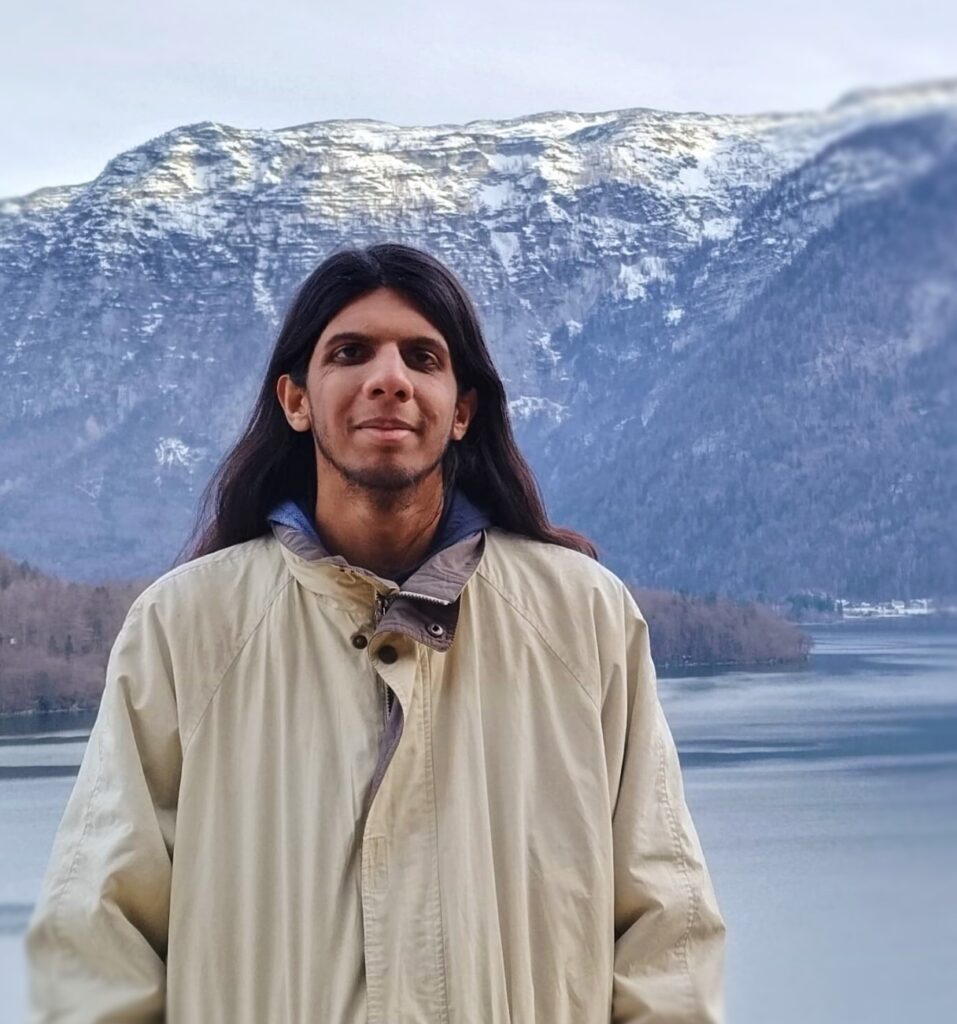
- Could you tell us a few words about your background? I grew up in Chennai, one of the major metropolitan cities in South India, and completed my bachelors in physics at Azim Premji University, Bangalore – another major city in South India. During my bachelor’s, I was drawn to the techniques and methodologies that are used in astrophysics and really enjoyed playing around with data from the GAIA observatory. This interest led to a masters in Astronomy & Astrophysics at the University of Amsterdam, where I got to specialise in astrophysics. I also spent a full year working on a research project, which solidified my interest in wanting to pursue a PhD in astrophysics. I was then lucky enough to be selected to pursue a PhD at the University of Bristol and become a part of the TALES network!
- What is the most exciting thing about your job ? Right now, being able to meet and work with people from all over the world is probably the most fun part of doing a PhD – especially since I am a part of TALES. From a more science perspective, I really enjoy that I get to work somewhere in the middle of observational and theoretical astrophysics – I really like trying to analyse and model the complex X-ray datasets that we have access to.
- Why did you choose to become a scientist ? I think I have always been interested in understanding how the world around us works and that naturally drew me to science and to physics – it was also very easy to develop an interest in astrophysics by just looking up at the sky and feeling a sense of awe. During my bachelor’s and my masters, this interest grew deeper, and I went from enjoying studying astrophysics to enjoying researching astrophysics.
- What is the main focus of your PhD project ? My project revolves around modelling the regions around accreting (supermassive) black holes that are very close to the event horizon – i.e., the “innermost regions”. To do this, we need to combine a wide variety of data and modelling techniques, from X-ray spectra, polarisation and variability to hydrodynamical simulations and radiative transfer. I am specifically focussed on modelling the spectral-timing properties – this involves using ray tracing software developed specifically to work in a general relativistic regime to create and fit various models of these inner regions to corresponding data. Being able to do this accurately will allow us to better understand the structure of the accretion flow in these regions, which in turn allows us to constrain more fundamental properties like spins, accretion rates, outflows, etc.
- What do you do for fun? I like going on hikes, and, when I can’t go outside because it’s raining (which is almost always here) I like playing games on my laptop. I started bouldering during my masters and have continued that into my PhD – I find that it is somehow both a great way to relax and get a workout at the same time. I have also been trying to get back into playing table tennis more regularly since I used to love playing it during my bachelors.
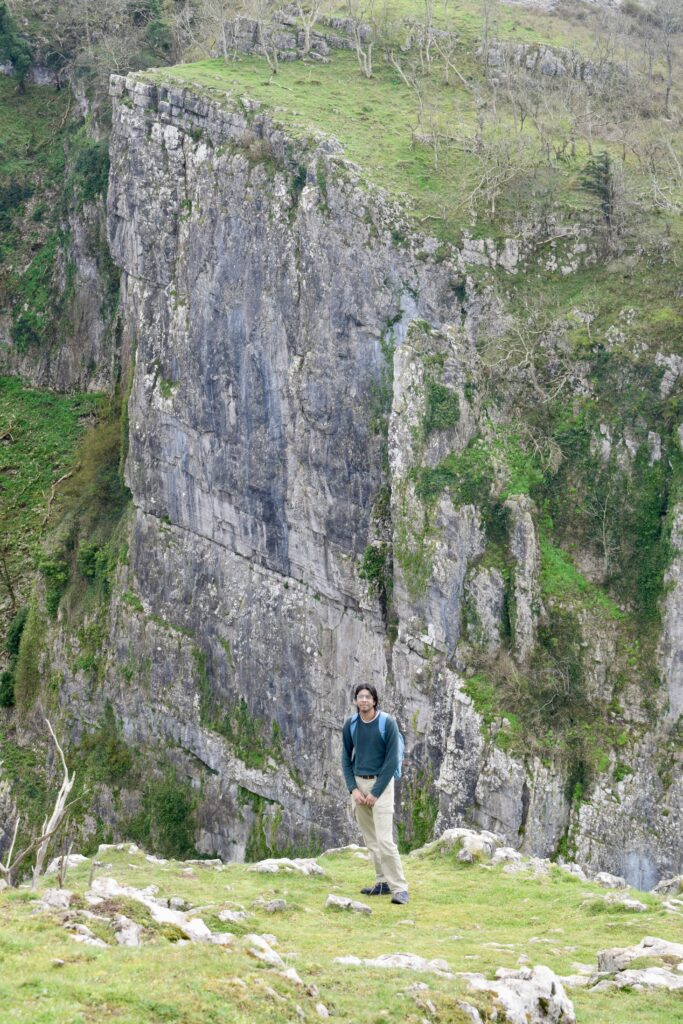
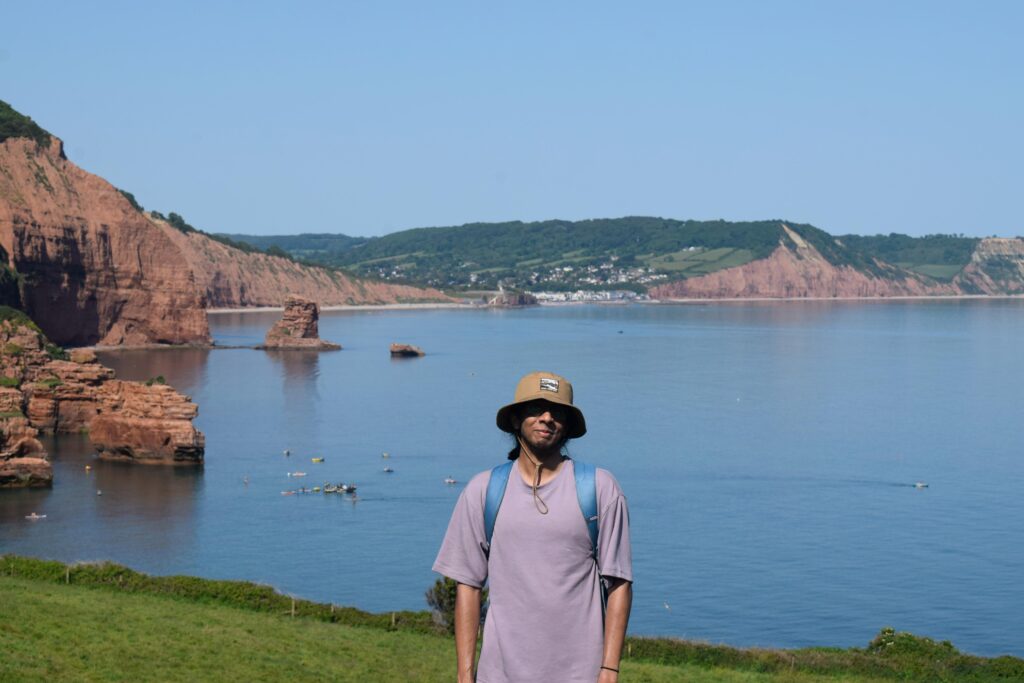
Figure Caption: Shashanth hiking at Cheddar Gorge (left) and along the Jurassic coast (up).

