

X-ray disc reverberation modelling of the X-ray/UV/optical spectral/timing properties of Fairall 9
TALES doctoral candidate Michail Polioudakis had his first paper accepted for publication in Astronomy & Astrophysics. The work started during Michail’s master studies under the supervision of prof. Iossif Papadakis and focuses on Fairall 9, a nearby Seyfert 1 galaxy with an unobstructed line of sight to the accretion disc around its central supermassive black hole. Using X-ray, ultraviolet, and optical data from an intensive Swift monitoring campaign with a near-daily cadence over 2.7 years, the authors tested whether X-ray reverberation, where the coronal X-ray emission is reprocessed by the accretion disc, can account for the source’s spectral and timing properties.
The X-ray emission in AGN is believed to originate from a hot region close to the supermassive black hole, often referred to as ‘X-ray corona’; however, its location, geometry, and powering mechanism remain highly debated. The model tested here assumes X-ray reverberation with a lamp-post geometry, where a compact, highly variable corona is located above the black hole, along its spin axis, and irradiates the disc below. Part of this radiation is absorbed and re-emitted as thermal ultraviolet and optical radiation, which is thought to be the origin of the observed variability at these wavelengths. Because the disc temperature decreases with increasing distance from the black hole, progressively cooler regions dominate the emission at longer wavelengths. Since X-rays take longer to reach these outer regions, the reprocessing delay is predicted to increase with wavelength, a signature that can be tested directly against observations.
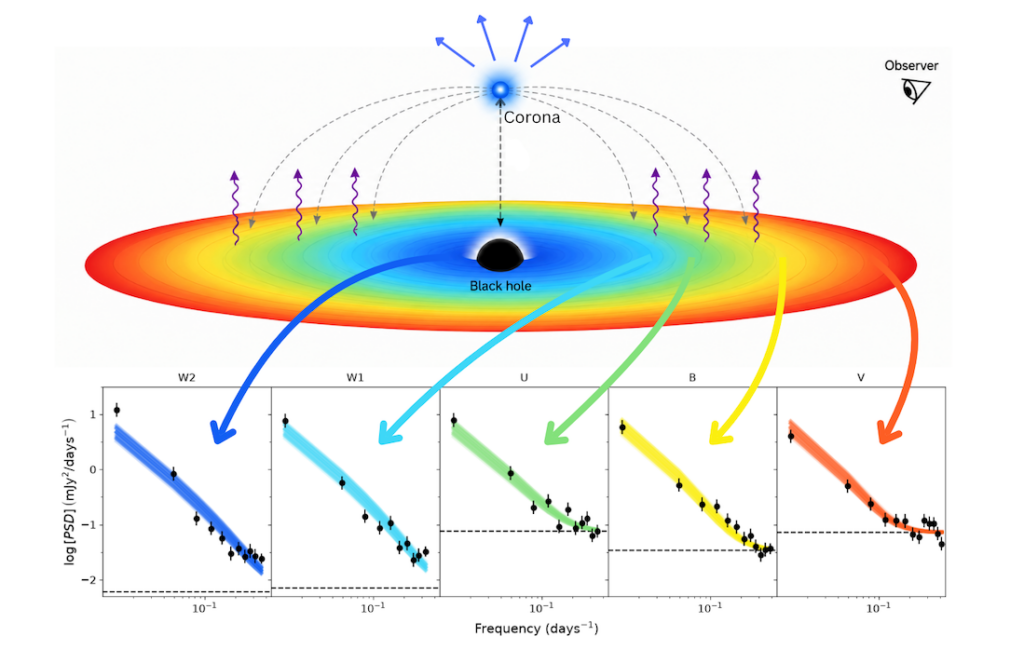
Figure caption. Top: Schematic illustration of the X-ray reverberation model with the lamp-post geometry. Bottom: UV and optical power spectra of Fairall 9, with increasing wavelength from left to right. Solid black circles show the observed PSDs in each UV/optical band, while colored solid lines show the accepted model PSDs. The horizontal dashed lines indicate the constant Poisson noise power level. Arrows from the disc towards the bottom PSD panels indicate qualitatively the disc-emitting regions associated with the corresponding UV/optical bands.
To test these predictions, the authors applied the X-ray reverberation model first to fit Fairall 9’s average spectral energy distribution, and then to predict its ultraviolet/optical power spectral densities (PSDs) and interband time lags using the same physical parameters. They found that a single, self-consistent parameter set reproduces all three observables simultaneously, with a corona that is powered by an unknown external mechanism, not directly associated with accretion. This is strong evidence that reprocessing of X-rays drives the variability of Fairall 9, and a further validation of the reverberation model against a real, well-sampled dataset

